
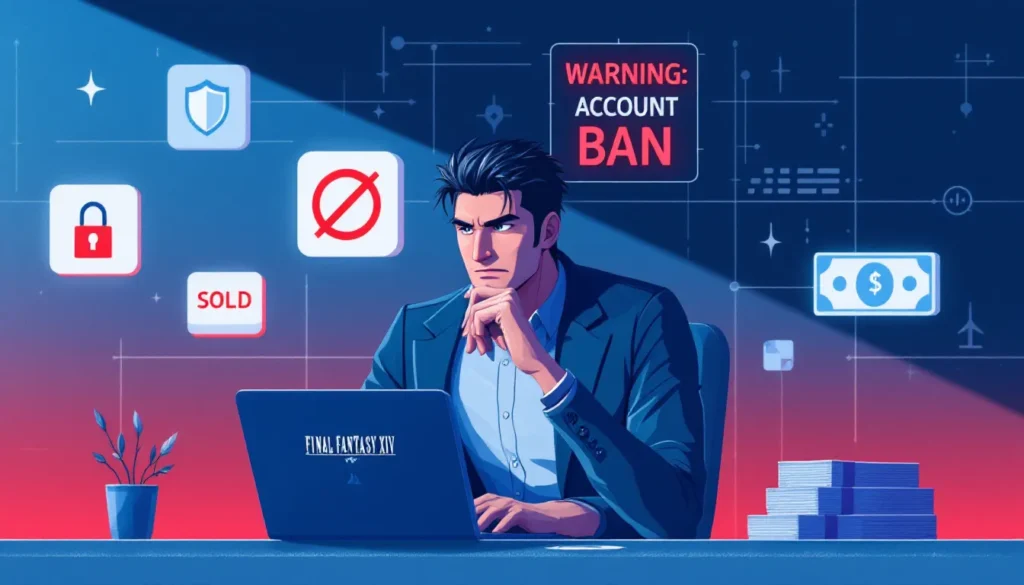
The allure of jumping straight into endgame content is understandable. A fully geared level 90 character with Savage raid clears, exclusive mounts, and years of progression already locked in? It sounds tempting. But the FFXIV account-for-sale market is a minefield of legal gray areas, security risks, and potential account bans. Whether you’re curious about buying an established character, thinking about selling your own, or just wondering what the community is actually doing, this guide cuts through the hype and lays out the hard truths. We’ll cover market realities, Square Enix’s stance, the actual dangers involved, and legitimate alternatives that won’t put your account at risk.
Table of Contents
ToggleKey Takeaways
- Buying or selling a Final Fantasy XIV account for sale directly violates Square Enix’s Terms of Service and results in permanent bans with no appeal process.
- Account prices range from $100–$3,000+ depending on gear progression and rarity, but buyers risk losing their entire investment within 30 days to 6 months of purchase.
- Security threats include sellers retaining account access, credential theft, and compromised accounts already flagged by Square Enix’s anti-RMT team.
- Legitimate alternatives like boosting services ($50–$400), self-farming through crafting and Market Board flipping, and story-skip potions ($18) provide faster progression without risking permanent suspension.
- If quitting FFXIV, simply let your subscription lapse or gift items to friends instead of selling—your account will remain intact and available if you ever want to return.
Understanding The FFXIV Account Market
Why Players Buy And Sell FFXIV Accounts
Final Fantasy XIV has a thriving secondary account market, and the reasons are straightforward. Some players want to bypass the 200+ hours required to level multiple jobs to endgame. Others are selling because they’ve quit the game, burned out on the grind, or need quick cash. A few are just consolidating characters and liquidating accounts they no longer play.
The appeal is easy to see: a level 90 Dragoon with Savage gear, rare mounts from limited-time events, and a treasure trove of crafting materials represents real investment. That’s why accounts regularly sell for anywhere from $300 to over $2,000 depending on progression, transmog collection, and rarity of mounts or titles.
But here’s the catch, every single one of these transactions violates Square Enix’s Terms of Service. And unlike some games where account trading exists in a murky gray zone, Square Enix actively bans accounts involved in sales. This isn’t speculation: it’s happened to thousands of players.
Current Market Trends And Pricing
As of 2026, the FFXIV account market has matured. Most accounts trading hands fall into these tiers:
Starter/Casual Accounts ($100–$300): Low-level characters, minimal gear, basic housing if any. These are mostly bought by people who want a shortcut through the story or a second character without the grind.
Mid-Tier Accounts ($400–$1,000): Level 90 main job, some Savage clears, a few event-exclusive mounts. These represent several months of active play and appeal to players wanting to skip the leveling phase.
High-End Accounts ($1,200–$3,000+): Fully geared Savages raiders, multiple job levels, rare mounts, extensive glamour collections, maybe a house or apartment. These sell to collectors and competitive players who want instant access to the raid scene.
The market has also shifted with the expansion cycle. After Dawntrail’s release, prices for endgame accounts dipped slightly because more players were actively raiding and the grind felt more achievable. That said, convenience always commands a premium. A player might justify $800 to skip six months of dungeons and gear grinding.
One thing worth noting: Chinese and Southeast Asian markets have different pricing and availability than North American or European servers. Account value also fluctuates based on seasonal events, accounts with Mog Station exclusives or limited-time raid rewards command higher prices in the months after those rewards disappear.
The Risks And Legal Implications Of Account Sales
Square Enix’s Terms Of Service Violations
Let’s be crystal clear: selling or buying a FFXIV account directly violates Square Enix’s Terms of Service. Section 3.1 explicitly states that accounts are non-transferable and cannot be sold, traded, or given away. This isn’t buried in legal fine print, it’s the core restriction.
Square Enix treats account sales as theft of service. When you buy an account, you’re receiving goods (the character, gil, items, housing) without paying Square Enix. When you sell, you’re commodifying something the company legally owns. Both actions breach contract.
Enforcement is real and active. Square Enix’s anti-RMT (real money trading) team regularly flags accounts involved in sales. They monitor third-party sites where accounts are listed, cross-reference buyer and seller patterns, and issue permanent bans. The ban isn’t just for the buyer, the seller’s IP and associated accounts often face suspension too.
Many players assume they’re safe because “tons of people do it.” That logic doesn’t hold. Square Enix bans in waves, not continuously. You might fly under the radar for months before a sudden account suspension hits. And unlike some publishers, Square Enix doesn’t give warnings, it’s usually straight to permanent termination.
Security Concerns And Account Theft
Buying an account means handing over credentials to a stranger. Here’s what can go wrong:
The Seller Keeps Access: Even after “selling” the account, the original owner can recover it using the registered email and security questions. They could log in weeks later, strip it of items and gil, reclaim the house (if owned), and kick you out. You’d have zero recourse since you bought the account illegally.
Compromised Account: Many sellers run the account through key farming bots or RMT operations before reselling. The account might already be flagged internally by Square Enix. Buying it means inheriting a ticking time bomb.
Personal Information Exposure: To claim the account, the buyer usually has to share or request password resets. This exposes personal data like email addresses, phone numbers, and payment methods to potential resellers or hackers operating the account marketplace.
Credential Stuffing: If the seller operates multiple accounts, your login credentials might get sold to other marketplaces or data brokers. Hackers could use them to probe other accounts you own.
Legitimate account resale platforms don’t exist in the FFXIV space. Most “sellers” are either bots running scams or players actually committing fraud. Verification and escrow systems that exist for MMO account trading on other games don’t work here because Square Enix invalidates the sale on their end anyway.
Potential Consequences For Buyers And Sellers
Let’s talk outcomes:
For Buyers: The most common result is permanent account ban within 30 days to 6 months. You lose all characters, gil, housing, items, everything. There’s no appeal process with Square Enix: they don’t reverse RMT-related bans. You’ve also just paid $500+ for an account that won’t exist soon. Some buyers also get IP-banned from the game servers, requiring a VPN to play on any account from that household (a violation of ToS if caught).
For Sellers: Same deal, permanent ban once detected. But there’s an additional risk: if the buyer gets caught and reports the seller (which happens), Square Enix cross-references transaction patterns and bans the original owner too. Sellers operating multiple accounts often see their entire roster suspended.
Criminal Gray Area: In rare cases, account sales involving significant money transfers can trigger fraud investigations if a buyer disputes the transaction with their bank or payment processor. This rarely leads to criminal charges, but civil disputes have happened, especially with high-value accounts.
Reputation Damage: The FFXIV community is tight-knit. Word gets around. Guilds, raid groups, and servers remember the player who bought an account or scammed others. If you ever create a new legitimate account, you might find yourself blacklisted socially.
The financial loss is real. You’re not just losing the account, you’re losing any investment you made into it, and you can’t claim the loss on your taxes (since it was an illegal transaction). It’s a pure financial hit with zero fallback.
Legitimate Alternatives To Buying Accounts
Boosting Services And In-Game Assistance
If the appeal of a fully geared character is the time savings, legitimate boosting services offer a legal alternative. Players can hire experienced raid teams or content creators to run them through dungeons, help them optimize rotations, or carry them through Savage tiers. This isn’t risking an account ban because the player owns their own character and is simply paying for assistance.
Boosting services typically charge per run or per week: a single Savage clear might cost $50–$150 depending on the team’s reputation, while weekly coaching runs hover around $200–$400. It’s not cheap, but it keeps your account secure and compliant with ToS.
Speaking of coaching, many high-level players offer character optimization. They’ll review your gear, teach you proper rotations, help you parse better (measure DPS), and identify where you’re losing damage. For raiders, this cuts months off the grind to clear Savage content legally.
Another option: gil buying. While selling accounts is banned, purchasing gil (the in-game currency) from third-party sellers is a separate category of TOS violation. Square Enix bans for this too, but it’s less immediate than account sales. That said, it’s still risky and not recommended. But, playing the market yourself, farming high-yield content, flipping crafted gear on the Market Board, or running treasure maps, is completely legal and can fund your own gear progression.
Trading Items And Gil Safely
Here’s what’s actually legal: trading items and gil with other players in-game. You can farm for hours, gather materials, craft gear, and sell it all on the Market Board or to other players. This is the intended economy.
Many players underestimate how fast you can gear up by farming or crafting. A crafter can generate millions of gil by making high-demand items. A gatherer farming Endwalker materials can earn 50k–100k+ gil per hour. Over a few weeks of casual play, you can fund gear upgrades without touching the black market.
The Market Board is your friend here. Prices fluctuate based on supply and demand, patch cycles, and seasonal content. Savvy players watch trends and make smart investments: buying materials when they’re cheap post-patch, crafting gear when demand spikes before raids open, selling mats before patch content drops.
Party Finder is also a legitimate avenue. You can join free Savage progression runs, clear Normal/Hard raids for weekly drops, or run trials that award gear. It takes longer than buying an account, but every piece feels earned.
Starting Fresh With Character Creation Tips
If you’re new to FFXIV, there’s no shame in starting from level 1. The story is phenomenal, many consider it the best single-player narrative in any MMO. Rushing past it by buying an account means missing decades of character development, world-building, and emotional payoff.
Here’s the path: pick a server (preferably a recommended or congested one for a healthy population), choose your starting class (Paladin, Marauder, Arcanist, Conjurer, or Pugilist), and follow the A Realm Reborn campaign. It’s slower than endgame content, but it teaches you the game’s systems. By the time you hit level 50, you’ll understand your class, dungeons, and the social fabric of the community.
Optional but helpful: buy a story-skip potion (around $18 on the Mog Station store) if you really want to get to endgame faster without risking an account ban. This lets you jump to the current expansion and level a new job without replaying the campaign. It’s not cheap, but it’s legal and safe.
Multiple jobs are also your friend. Once you hit level 90 on one class, leveling alts is 10x faster thanks to rested XP and more efficient dungeons. Many players run 5–8 jobs at cap without burning out. This gives you variety without needing to buy a pre-made account.
One more thing: housing and glamour can be farmed purely through gameplay. Autists will tell you housing is “impossible” to get, but housing plots rotate every few months during scheduled purchasing periods. With some gil saved up and patience, you can own a Free Company house or an apartment. Glamour, the cosmetic side of endgame, comes from dungeons, raids, events, and crafting.
How To Protect Your Account If You Play FFXIV
Strong Password Management And Two-Factor Authentication
This applies whether you’re buying an account (terrible idea, but if you do) or protecting your legitimate one.
Use a unique, complex password: Don’t use the same password across multiple accounts. If one site gets breached, hackers will test that password on your FFXIV login. Use a password manager like Bitwarden or 1Password to generate and store 20+ character passwords with mixed case, numbers, and symbols.
Enable two-factor authentication (2FA): This is non-negotiable. Square Enix supports authenticator apps (Google Authenticator, Authy) and one-time password (OTP) tokens. Even if someone steals your password, they can’t log in without the second factor. Set this up immediately on any FFXIV account you care about.
Secure your email: Your Square Enix account is tied to an email address. If hackers compromise that email, they can reset your FFXIV password. Use a strong password and 2FA on the email account too. Don’t reuse emails across services.
Avoid authenticator backups in the cloud: If you use an authenticator app, enable backup codes (which Square Enix provides). Store these in a secure location, not on your phone, not in an email, not on the cloud. They’re your account recovery nuclear option.
For players buying accounts (again, don’t), changing the password and email immediately is the first step. But by that point, the damage is done, the seller still knows the original email and can recover the account whenever they want.
Recognizing Scams And Phishing Attempts
Account marketplace sites are hunting grounds for scammers. Here’s what to watch for:
Fake Square Enix emails: Phishing emails pretending to be from Square Enix often claim your account is “compromised” or “needs verification.” Real notifications from Square Enix come to your registered email and direct you to log in through the official lodestone site, not a link in the email. If you get a suspicious email, log into your account directly via the Mog Station and check your account status. If there’s a problem, Square Enix will notify you there first.
“Account selling” Discord servers and private shops: These are the primary vector for scams. A seller posts an account, you pay, they vanish or the account gets recovered by the original owner. There’s no recourse because you bought stolen goods. Some “sellers” are actually account farmers using bots: they don’t care if you get caught because they’ve already moved on to the next buyer.
Too-good-to-be-true pricing: A fully geared Savage account for $200? It’s either a scam or a stolen account that will be reclaimed. Legitimate pricing reflects the time investment.
Requests for personal info: Legitimate account sales (which are still against ToS) don’t require your real name, ID, or payment method beyond what’s needed for the transaction. If someone asks for extra personal data, they’re either setting up identity theft or verifying you for law enforcement.
Pressure to buy quickly: Classic social engineering. “Account available for 2 hours only” or “buyer ahead of you” creates urgency that bypasses your critical thinking. Real sellers wait for interested buyers.
The simplest defense: don’t buy accounts. It’s not just that you’ll get scammed (though you might). It’s that legitimate transactions violate ToS and result in permanent bans. There’s literally no upside beyond convenience, and the downside is losing your entire investment.
What To Do If You’re Considering Selling Your Account
Important Questions To Ask Yourself
If you’re thinking about selling your FFXIV account, take a step back. These questions matter:
Why are you actually selling? If it’s burnout, selling the account won’t fix it. You might regret it within weeks and want to return. If it’s financial hardship, there are better ways to earn money that don’t risk legal trouble. If you’re quitting permanently, consider if you might return later (FFXIV has a “world of warcraft refugees” phenomenon where players cycle back). Account sales are final.
How much money are you realistically getting? Market prices exist, but actual sales often happen at discounts. After taxes (if you report it, which you should) and transaction fees, a $1,000 account might net you $700. Is that worth the account ban, potential fraud investigation, and permanent loss of years of progression? Compare that to what you’d earn in 40–50 hours of actual work.
Can you handle the legal gray area? Selling accounts isn’t explicitly criminal in most jurisdictions, but it’s breach of contract. If the buyer disputes the transaction or reports you, you might face civil action or be contacted by Square Enix’s legal team. How comfortable are you with that?
Is your account actually worth selling? Your assessment of what buyers will pay might be wildly optimistic. A casual account with one level 90 and some dungeon gear? Maybe $300. A Savage raider with rare mounts? $800–1,200. But accounts move slowly, and prices drop as buyers get cautious. You might list for $1,000 and realize the market only pays $600.
Most players who sell accounts do so during transitions, moving, major life changes, or genuine quitting. Even then, many regret it. The account becomes a phantom memory of the time you invested. You can always take a break and return: you can’t un-sell an account.
Safe Closure And Account Transition
If you’ve decided to quit FFXIV for real (not just temporarily), here’s the legitimate way to handle your account:
Let your subscription lapse: You don’t need to sell or delete anything. Simply cancel auto-renew and let your subscription end. Your account will go inactive but remain intact. If you ever return, everything is there.
Gift items to friends: You can transfer gil and items to other players through in-game trading or housing storage. This is legal and lets you help your FC (Free Company) and friends. It’s a nice closure and better than deleting everything.
Leave your housing gracefully: If you own a house, you can demolish it or let it auto-demolish if you don’t pay the plot tax. This frees up housing for other players and is considered polite in the community. Alternatively, you can transfer it to a trusted FC leader.
Write a farewell message: Leave a free company notice or post in your server’s Discord explaining you’re stepping back. The FFXIV community is supportive of people taking breaks. Saying goodbye builds goodwill if you ever return.
Document your account for your own records: Take screenshots of your achievements, titles, glamour, and rare items. It’s nice to look back on.
Don’t engage with account marketplace sites: The moment you contact a seller or list your account, you’ve started the legal violation. You can quit the game without crossing that line.
The key insight: you don’t have to sell your account to quit. You can just stop playing. Your account isn’t a liability: it’s a snapshot of your time in Eorzea. Years from now, you might want to boot it up, walk around Limsa Lominsa, and remember why you loved the game. If you sell it, that option is gone forever.
Conclusion
The FFXIV account market exists because the game’s endgame is compelling and time-intensive. But buying or selling accounts is a gamble with terrible odds. Square Enix actively bans both buyers and sellers, security risks are real, and the legal gray area isn’t worth the convenience or quick cash.
If you want to skip leveling, buy story skips on the Mog Station. If you want better gear, farm it yourself or hire legitimate boosting services. If you want to quit, just quit, your account will be waiting if you return.
For Final Fantasy XIV time card options and other legitimate in-game purchases, use Square Enix’s official Mog Station. For community advice and builds, the Final Fantasy XIV Reddit community is active and helpful. If you’re curious about class balance and tier rankings, check Final Fantasy XIV Classes tier lists to see what’s currently meta.
The safest path is always the legitimate one. Your account, your peace of mind, and your time investment in Eorzea are worth protecting. Don’t throw them away for a shortcut that won’t stick around anyway.

